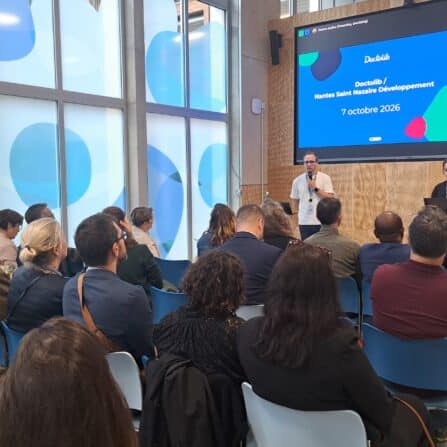
“By reusing health data, we have the opportunity to transform healthcare and generate new knowledge.”

A key player in the metropolitan area and in regional development, the Nantes University Hospital is undergoing a transformation with the addition of new buildings that will soon house healthcare professionals, researchers, and new healthcare companies.
Pierre-Antoine Gourraud, university professor and hospital physician at the University of Nantes School of Medicine and founder of the Health Data Warehouse, explains the university hospital’s major role in regional transformation and outlines the region’s needs in terms of attracting new healthcare companies.
The University Hospital joined the governing body of the Nantes Saint-Nazaire Développement agency in 2024. How does the University Hospital intend to exert influence within this regional consortium?
The Nantes University Hospital (CHU), as the region’s largest employer with more than 13,000 professionals engaged in patient care, teaching, research, and innovation, is a major player in healthcare within our region. As such, it contributes to the region’s development strategy, particularly through its support for initiatives led by the Nantes Saint-Nazaire Développement agency.
The new hospital will open in the second half of 2027. How will this new facility benefit the region?
The new hospital will be located in the heart of the future healthcare district. This European-scale ecosystem will drive innovation through the integration of three major facilities:
- a health sciences campus, an exceptional center for education, with more than 7,000 students enrolled in medical or paramedical programs
- a new health research institute, IRS 2020, which promotes the transfer of knowledge from basic research to patients
- as well as a one-of-a-kind business and research-and-development campus that brings together innovators in the health sector.
The GINA building, the cornerstone of this corporate and research campus, will serve as a hub within the university hospital district for incubating innovative healthcare projects and solutions. It will host healthcare startups, small and medium-sized enterprises (SMEs), large corporations, teams from the Nantes University Hospital (CHU), and its institutional partners to develop innovations that will transform our healthcare system. The GINA building will notably house the facilities dedicated to the Nantes University Hospital’s innovation services, the Fabrique de l’Innovation en Santé ®.
This unprecedented, large-scale project will give a major boost to healthcare in the region; it will bring together in one place the momentum already building around health data and AI. In Nantes, we already have everything it takes to be a leading player in healthcare. For starters, we’re the ideal size to form a formidable team.
Our additional needs are primarily focused on digital health, data, and AI, but also on all of our areas of expertise where digital technology is applied

And along with it, the future healthcare district, featuring new infrastructure to accommodate healthcare companies. What kinds of companies or stakeholders does the region need?
We are already a well-recognized region and are fortunate to be home to some outstanding healthcare companies and promising startups. It’s no coincidence that Doctolib, a renowned and large company, chose to set up shop in Nantes.
Our additional hiring needs are primarily focused on digital health, data, and AI, but also on all our areas of expertise where digital technology is applied—such as immunology, oncology, nuclear medicine, cardiology, neurovascular medicine, vulnerabilities, and more.
You are an AI specialist in healthcare. How do you think AI will help improve the health of residents in this region?
In Nantes, we have a university hospital that is opening the door to data reuse, which is why we’re seen as a model for the use of data in healthcare. This is what I call “solidarity”—that is, the development of secondary uses for data that can be repurposed. In this region, which is a leader in data reuse, we’re working to reuse health data. And so we have the opportunity to transform healthcare and generate new knowledge.
Today, there is a great deal of excitement surrounding artificial intelligence. The raw material for these algorithms is data. Because without data, there is no artificial intelligence. That is why we created the Data Clinic at Nantes University Hospital. What also matters is how well this data is tailored to the local region; American models, for instance, are not suited to the profile of patients in this region. It is in this sense that we are able to better serve the local population.