
On Tuesday, April 16, 2024, Johanna Rolland, Mayor of Nantes and President of Nantes Métropole, and Peter Tschentscher, Mayor of Hamburg, signed in Hamburg a new strategic partnership aiming to deepen cooperation on seven targeted themes: economy and innovation, health, higher education and research, vocational training, cultural and creative industries, culture, and remembrance policy.
Green capitals of Europe
Both large port cities and “Green Capitals of Europe” since the early 2010s, Nantes Métropole and Hamburg share many similarities and have both made sustainable development and social policy key priorities of their political action. This new partnership continues a long history of Franco-German friendship, initiated in the 2000s and formalized in 2017 with the signing of an initial cooperation framework.
Cooperating on maritime transport decarbonization and renewable energies
The newly signed strategic partnership will enable the two metropolitan areas to strengthen cooperation in the fields of maritime transport and renewable energies.
“This strategic partnership between Nantes Métropole and Hamburg, Germany’s second-largest city and first port, is an opportunity to provide the stakeholders of our metropolitan areas with a stronger framework for exchange and joint work on shared challenges, such as maritime transport, marine energies, the development of health districts, or vocational training in sustainable construction,” said Johanna Rolland, Mayor of Nantes and President of Nantes Métropole.
Both port cities, Nantes and Hamburg share the ambition to decarbonize their maritime transport. In Hamburg, this commitment is reflected by the DLR – Institute of Maritime Energy Systems, which researches and develops innovative solutions for defossilization, emission reduction, and the increased use of renewable energy in the maritime sector. In Nantes, the recently inaugurated MEET2050 (Maritime Economical and Environmental Transition) brings together experts, project leaders, academic and economic stakeholders to drive innovation in the field of decarbonization.
Joint maritime events
The strategic partnership between Nantes Métropole and Hamburg also includes plans for regular exchanges between stakeholders of both cities, as well as cross-participation in several events: the Seanergy marine energy exhibition (Nantes, June 26-28, 2024); Wind for Goods, the international wind-powered shipping event (Saint-Nazaire, June 19-20, 2025); and SMM, the world-leading maritime industry trade fair in Hamburg (September 3-6, 2024), with a shared focus on wind propulsion.
Collaborations planned on renewable energies
The two metropolitan areas intend to strengthen their cooperation on renewable energies, particularly offshore wind. Exchanges are planned between the Erneuerbare Energien Hamburg Cluster, France Hydrogène, and WEAMEC, which brings together academic stakeholders and companies involved in marine renewable energies in the Pays de la Loire region. These exchanges will help identify collaboration opportunities on topics such as hydrogen and port infrastructure.
A delegation including economic partners
Alongside Johanna Rolland, many partners took part in the trip, including Nantes Saint-Nazaire Développement, the Port of Nantes Saint-Nazaire, the Director of ENSA (School of Architecture), maritime economy clusters, Pôle Mer Bretagne Atlantique (representing MEET2050), France Hydrogène, Open-C, and WEAMEC (representing CARGO). The company Johnson Controls, specialized in refrigeration machines and heat pumps and a rising player in the decarbonization market, also joined the delegation: its latest major order, the largest recorded to date, was placed by the city of Hamburg.
“Ensuring a comfortable sound and vibration environment in living spaces” is the mission of Atelier 7 hz. Based in Montreal and Quebec, the 15-person engineering firm provides acoustics and vibration consulting services for building construction and environmental noise monitoring. Atelier 7 hz primarily works during the design phase but also monitors construction phases and performs performance verification measurements. The firm is involved in large-scale projects such as the Vaudreuil-Soulanges hospital near Montreal (comparable in size to the Nantes University Hospital). 7 hz’s scope extends beyond buildings: “we measure noise and vibrations inside, but also nuisances generated by highway construction or train traffic,” explains Raphaël Duée, founder and president.
Connected monitoring stations
Through a research tax credit granted by Canadian authorities, Atelier 7 hz has developed “permanent monitoring stations” for tracking noise and vibrations. Powered by solar panels, these autonomous devices are installed near construction sites, highways, or airports to monitor their acoustic and vibrational environment. The collected data is transmitted in real-time to a server. “We’ve developed an additional feature based on artificial intelligence that can detect events like the passage of an airplane or train, providing detailed statistical analyses,” says Raphaël Duée.
From Montreal to Nantes
After twelve years in Quebec, Raphaël Duée decided to return to Europe with his family, with the goal of replicating the company’s success. “I have no roots in Nantes and my wife is Canadian. After studying several cities, Nantes appeared to offer the right environment for both family life and professional development, thanks to its energy, the presence of major projects, and proximity to the ocean. I also appreciated the more relaxed approach to work relationships here. Nantes Saint-Nazaire Développement gave us the keys to understand the local environment and facilitated our first steps,” he explains. Next step: business development, with the goal of building a new team to cover the western region of France.
Learn more about Atelier 7 hz
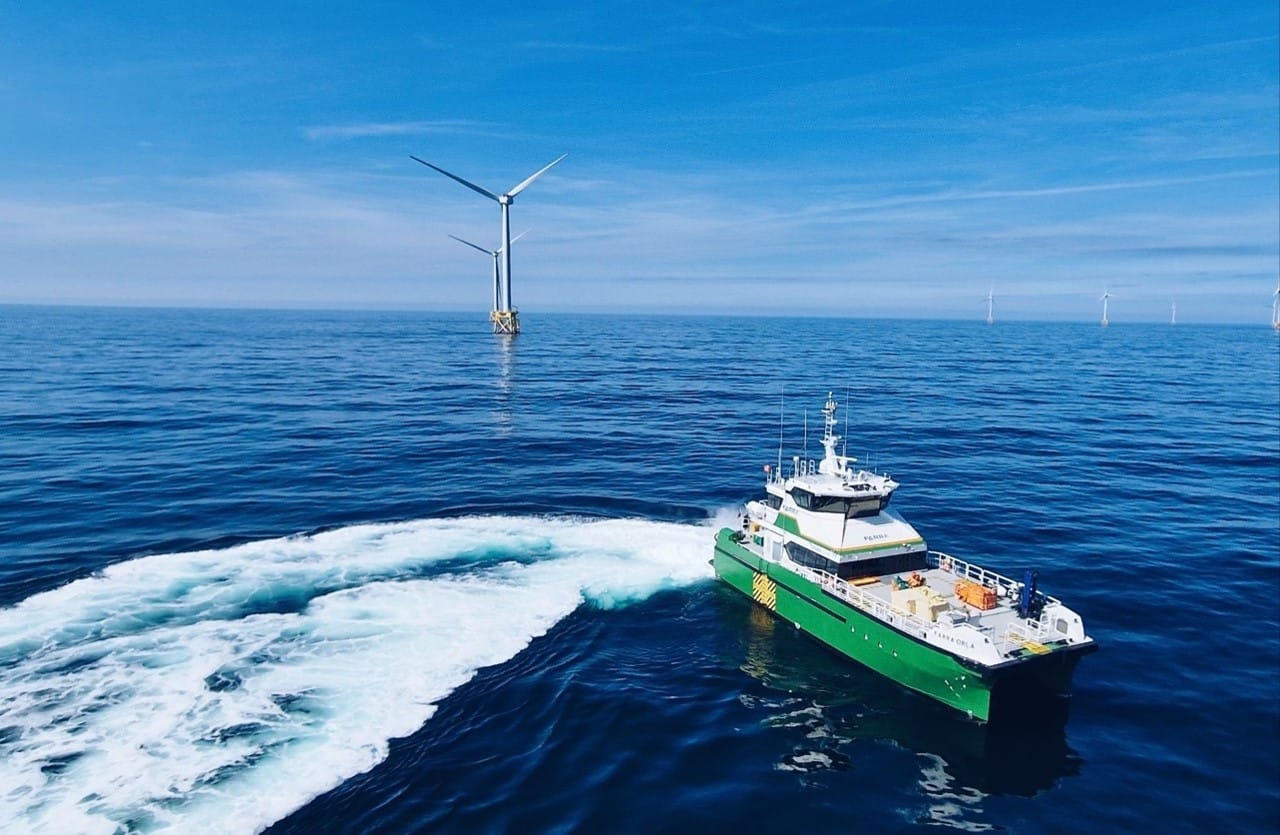
Farra Marine establishes its French subsidiary in NantesThis Irish company has chosen Nantes for its establishment in France. Farra Marine was founded in 2020 in Ireland by Martin Rice and Jason Parker, two marine engineers who have spent their careers working at sea. “Farra Marine now operates a fleet of eight state-of-the-art CTVs (Crew Transfer Vessels), 27-meter vessels capable of accommodating up to 24 passengers. Six additional vessels are expected to be delivered by the end of Q1 2024, with the goal of reaching 40 vessels in Europe within the next five years. Farra Marine is ready to support its French clients in the development of offshore wind farms with the expertise we’ve built up in the European market,” state the two co-founders.
Close ties with the marine energy sector
The choice of Nantes for establishing its French office was a strategic decision for Farra Marine. “Several French clients from the offshore wind market are based in the Nantes and Saint-Nazaire region. Moreover, Nantes is less than four hours away from the first offshore wind farms built in France since 2022 (Saint-Nazaire, Saint-Brieuc, Fécamp, and Courseulles-sur-Mer), as well as from future projects in Normandy, Brittany, and Pays de la Loire,” explains Audrey Leconte, Head of Business Development Europe at Farra Marine. “In Nantes, I built strong connections with the industrial network Neopolia, which connected me with Nantes Saint-Nazaire Développement and the regional agency Solutions&Co. They supported us in setting up Farra Marine France and provided valuable services. We also appreciated the support from the Pays de la Loire Region. Since July 2022, we have been involved in the construction of the Banc de Guérande–Saint-Nazaire offshore wind farm. We are also operating one of our vessels for the construction of the Fécamp offshore wind farm until 2024,” she continues.
To recruit seafarers, they must be trained
With offshore wind projects in the UK, France, Germany, Denmark, and the Netherlands, Farra Marine is experiencing rapid growth. “We now have 15 people on the management and support teams and about 55 crew members on board our vessels,” says Audrey Leconte. “The company will employ nearly 100 people by early next year. To meet our clients’ demands, we have an investment plan in place for the training and development of French crews. However, if we want to meet France’s offshore wind farm construction targets, we must urgently accelerate the training of French seafarers on CTVs. Currently, we provide this training ourselves, which can take several months or even years. Discussions are ongoing with regional authorities and the local offshore wind ecosystem to develop dedicated CTV crew training programs.”