"By 2030, we will need five times as much electricity to power existing industries and new industrial facilities."

What is the goal of Loire Estuaire Décarbonation?
The overall goal of Loire Estuaire Décarbonation (ADELE) is to accelerate the region’s decarbonization and its ecological and energy transition, given that it currently relies on fossil fuels for 70% of its energy. Since 2022, Saint-Nazaire Agglo, Estuaire et Sillon, Nantes Saint-Nazaire Port, and some twenty industrial companies have been committed to this initiative, which aims to achieve carbon neutrality by 2050. The first phase of the program, which has received a 3.2 million euro grant from France 2030 through the ZIBaC call for projects administered by ADEME, aims to conduct feasibility and opportunity studies to kickstart this transformation. A second phase of the program will begin in the summer of 2026 and last up to five years, during which more detailed engineering studies will be conducted.
How does the Nantes-Saint-Nazaire region rank nationally in terms of carbon emissions?
We’re talking about 5 million metric tons per year in industrial CO2 emissions. This makes it the fourth-largest industrial zone in France in terms of emissions, after Dunkirk, Fos-sur-Mer, and Le Havre. The collective goal is to ensure the resilience of this region in a world that is less dependent on fossil fuels. The Loire Estuary is one of 11 low-carbon industrial zones in France working toward decarbonization.
Two new synthetic fuel production plants are under development, one for the aviation sector and the other for the maritime sector
What will be the first concrete project?
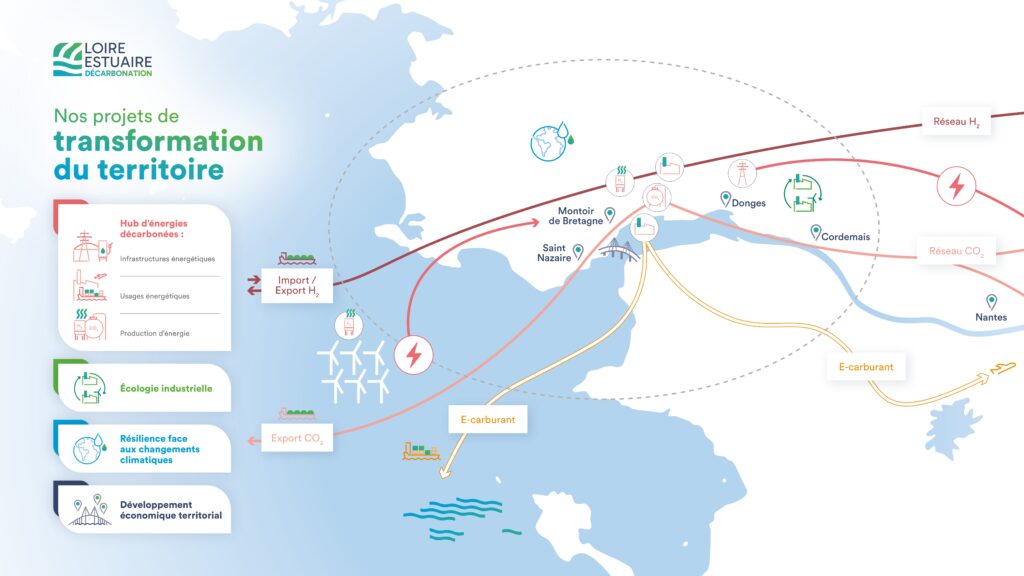
The Loire Estuary region is a major player in France’s energy supply, through which 10% of the primary energy consumed in France passes. The vision shared by public and industrial stakeholders is to ensure the long-term viability of this asset in a world less dependent on fossil fuels and to develop what is known as a carbon-free energy hub. This hub will first require the development of energy infrastructure: electric grids, CO2 infrastructure, hydrogen infrastructure, district heating networks, and more. Regarding power grids, for example, the goal is to increase the region’s electrical capacity fivefold by 2030—a project led by RTE. This will enable the electrification—and thus the decarbonization—of existing industries, as well as the establishment of new industries, including producers of synthetic fuels. In practical terms, this will involve strengthening electricity transmission capacity between Cordemais and Saint-Nazaire.
Is there another project related to CO2 transport and storage?
In fact, the GOCO2 project aims to decarbonize three sites that are among France’s largest industrial emitters: the Lafarge-Holcim cement plant in Saint-Pierre-la-Cour (Mayenne) and the Heidelberg Materials plant in Airvault (Deux-Sèvres), as well as the Lhoist lime production plant in Neau (Mayenne). The CO₂ from these sites will be captured and transported via pipeline to a future CO₂ terminal in Montoir-de-Bretagne, from where it will be shipped to permanent geological storage sites. By 2030, GOCO2 will enable the storage of 2.2 million metric tons of CO2 per year, equivalent to the emissions of the Nantes metropolitan area.
Will it be possible to recover some of this CO2?
In fact, a portion of the captured CO2 can be used as a feedstock for the production of synthetic fuels. Two new synthetic fuel production plants are under development in Montoir-de-Bretagne and Donges, one for aviation (e-kerosene) as part of the Take Kair project led by Hynamics (a subsidiary of EDF), and the other for maritime transport (e-methanol) as part of the Green Coast project led by Lhyfe and Elyse Energy. These are projects that did not exist three years ago and are expected to come online by 2031. Each of these plants represents an investment of approximately 1 billion euros. These plants will also have significant electricity needs, so it is clear why strengthening the power grid is important—it enables the establishment of such facilities and becomes a factor in the region’s competitiveness.
What are the industrial sectors with the greatest potential for the region?
This is also part of the discussion. Nantes Saint-Nazaire Port and local authorities are exploring ways to free up public and private land in order to optimize the use of existing land and accommodate new industrial facilities. These stakeholders are also considering the development of a strategy to enhance the region’s attractiveness in low-carbon industrial sectors, such as offshore wind power, sail-powered transportation, and low-carbon water sports.
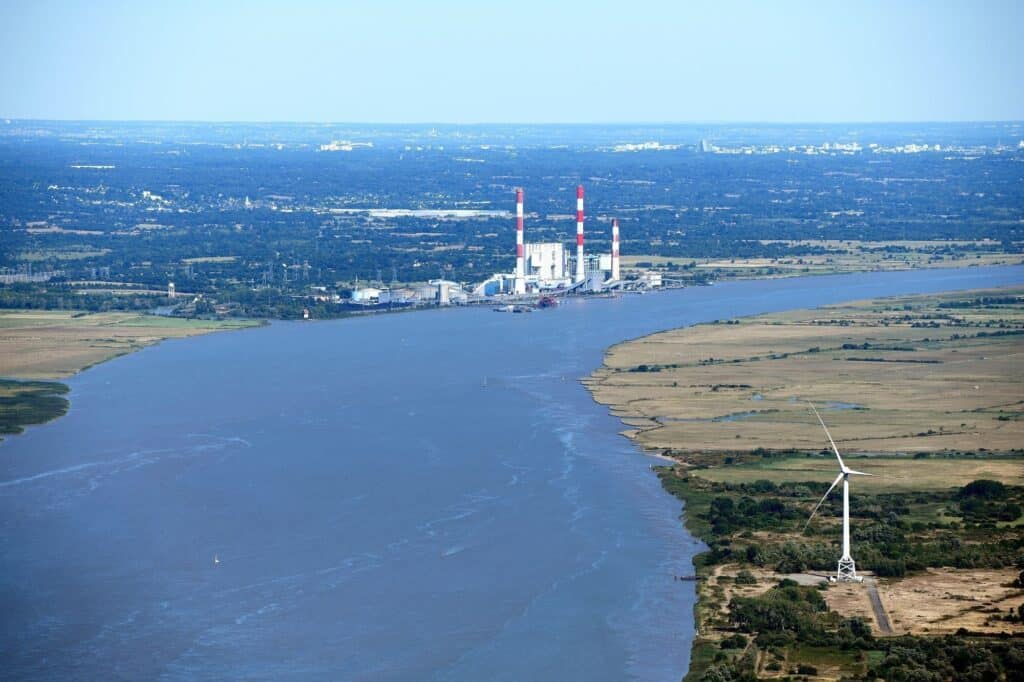
The estuary will also have to adapt to climate change. How is this threat being addressed?
In fact, Nantes Saint-Nazaire Port and Saint-Nazaire Agglo are also conducting a study on the resilience of the industrial-port area in the face of climate change. The study aims to assess the region’s vulnerabilities to climate-related risks (storm surges, storms, floods, droughts, etc.) and to develop a corresponding adaptation plan.
We are also focusing on water management, which is a major issue for the region. This involves assessing current and future water consumption by industrial facilities and exploring the reuse of wastewater from treatment plants to meet these industrial needs.
Do you have a project in industrial decarbonisation?