How to plan a sustainable event: tips from the experts
1. Start by considering the purpose and format of the event
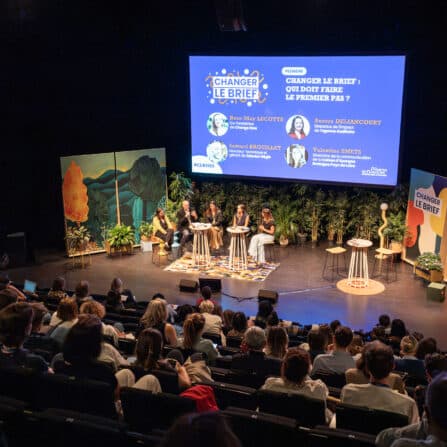
Before choosing a venue or a service provider, it’s important to clarify the purpose of the event: Why are the participants gathering? What outcomes should be expected? Is it worthwhile to have participants travel to the event? “ “You have to ask yourself whether attending the event is worthwhile for the person coming,” emphasizes Rose-May Lucotte, founder of the ChangeNow event. She continues: “You also have to carefully plan the logistics of the meetings so that the right connections are made .” Caroline Mignon, president of the Acteurs du Tourisme Durable association, also encourages taking “a step back to question the value of the event, the way we do things,” and the legacy the event leaves behind.
2. Include environmental and social commitments in the brief from the outset
Objectives must be established at the outset, shared with the procurement, communications, and CSR teams as well as service providers, and then maintained throughout the production process. Aurore Deliancourt, chief impact officer at the Auditoire agency, recommends “fighting just as hard for a CSR charter as for a graphic charter” and points out that, without explicit expectations, the issue risks being overlooked. Valentine Smets, Director of Communications at Caisse d’Épargne Bretagne Pays de Loire, confirms “the importance of establishing our needs from the outset, in the brief” and of “asking all the right questions early on” to maintain a clear guiding principle with all stakeholders.
3. Incorporate technical skills early on
A responsible goal can only be realistic if its feasibility, compliance, timeline, and staffing requirements are examined in advance. Samuel Brouillet, managing director of Zebulon Régie, believes that the service provider should “ideally be involved from the very beginning.” ” If brought in too late, the service provider may uncover “blind spots” regarding compliance budgets, team schedules, or the selection of service providers.
4. Make sustainable mobility a key criterion
Transportation for participants is a major factor in an event’s carbon footprint—one that must be addressed even before the final venue is selected. In fact, transportation often represents “by far the largest component of tourism’s greenhouse gas emissions,” notes Caroline Mignon. Therefore, the choice of venue must be based on the invited participants, and accessibility via low-carbon transportation should be prioritized. Finally, when the available options do not allow for the ideal solution, it is important to seek the best compromise. For example, for a seminar, the Caisse d’Epargne Bretagne Pays de la Loire chose to charter buses to transport its 2,300 employees. “We were able to maximize the occupancy rate of our vehicles to still minimize our carbon footprint,” explains Valentine Smets, communications director at Caisse d’Épargne Bretagne Pays de la Loire.
5. Incorporate responsible choices into the overall budget
The event’s carbon footprint, reuse, waste reduction, and material recovery should not be viewed as options that can easily be eliminated. Valentine Smets explains that these expenses are now “no longer a separate line item but are part of the event’s overall production budget.” This approach to eco-design in event planning requires making different trade-offs, such as doing without carpeting or certain materials. And in the end, “when the event experience is reimagined as a whole, it isn’t necessarily more expensive.”
6. Design an eco-friendly exhibition layout and find new uses for materials
Set design and staging must be planned to minimize resource use, avoid single-use items, promote reuse, and identify recycling channels early on. Aurore Deliancourt cites a project in which the agency chose to “find recycling partners to truly repurpose a large portion of the set rather than just throwing everything in the dumpster.” And often, time works against organizers. Hence the importance of planning ahead to make the circular economy central to event organization and avoid last-minute decisions that increase the environmental impact of the set design.
7. Prioritize cooperation and measure success differently
Responsibility does not rest solely with the client or the service provider. “Responsibility cannot be delegated. Everyone shares in the responsibility,” says Aurore Deliancourt. Leaders must foster a dialogue that allows everyone to suggest improvements and highlights the efforts that have been made. Finally, evaluation cannot be limited to the budget or the number of participants: Caroline Mignon calls for measuring performance “through the lens of social, environmental, and governance issues.” It is this shift in the criteria for success that will enable a lasting transformation of event practices.
A question about organising your corporate event in Nantes Saint-Nazaire?

Photo credit © Jérémy Jéhanin