Get to know your area so you can talk about it more effectively
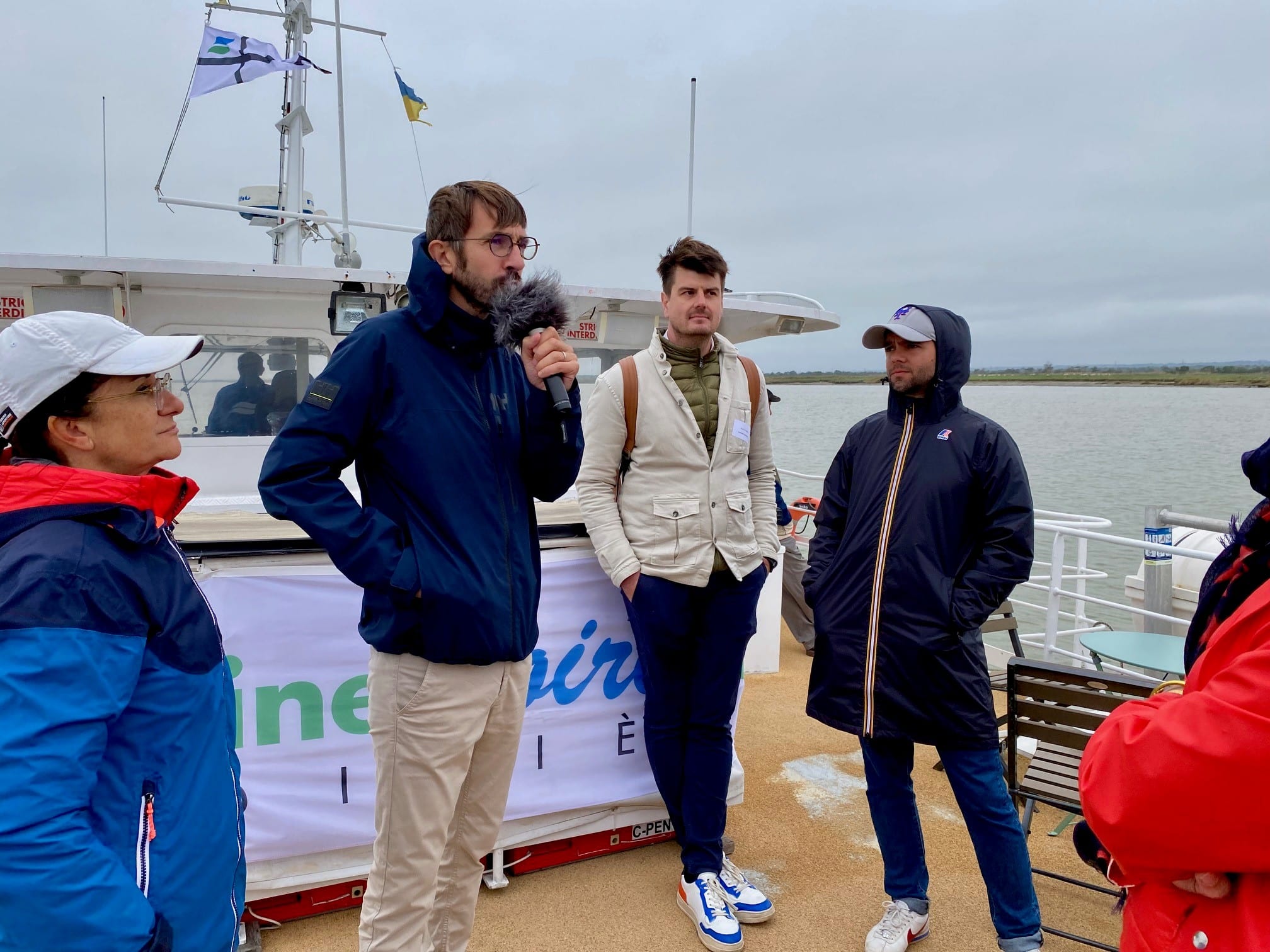
To learn about the region’s unique characteristics in order to better showcase it. That was the goal of this unusual cruise, featuring presentations by three key players: Nantes Saint-Nazaire Port, Naval Group, and Estuarium.
The area’s capacity for renewal became evident right from the start of the journey, as we passed through historic sites undergoing profound transformation. On the Quai des Antilles, for example, the once-bustling commercial activity has given way to one of Nantes’ most iconic promenades. The Bas-Chantenay neighborhood, a hub of Nantes’s naval history, is undergoing a major transformation to accommodate innovative economic activities related to the maritime and nautical sectors.
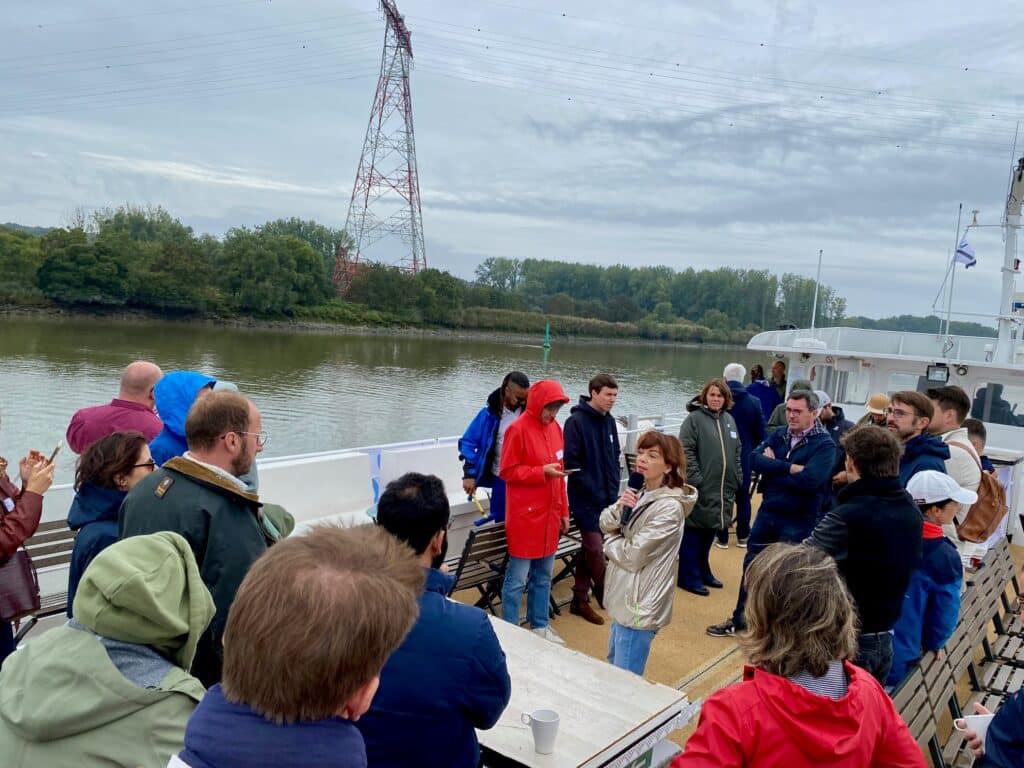
Natural Heritage and Industrial Landmarks
As the riverbanks flashed by before the eyes of the Audacieux, Cécilia Nicolas, director of Estuarium, explained how the river has been shaped by the commercial and industrial activity of Nantes and Saint-Nazaire. The landscape, which has been constantly changing, now gives nature plenty of room to thrive —22,000 hectares on both sides of the river are designated as a Natura 2000 site—as evidenced by the marshes that now stand where the old docks once were.
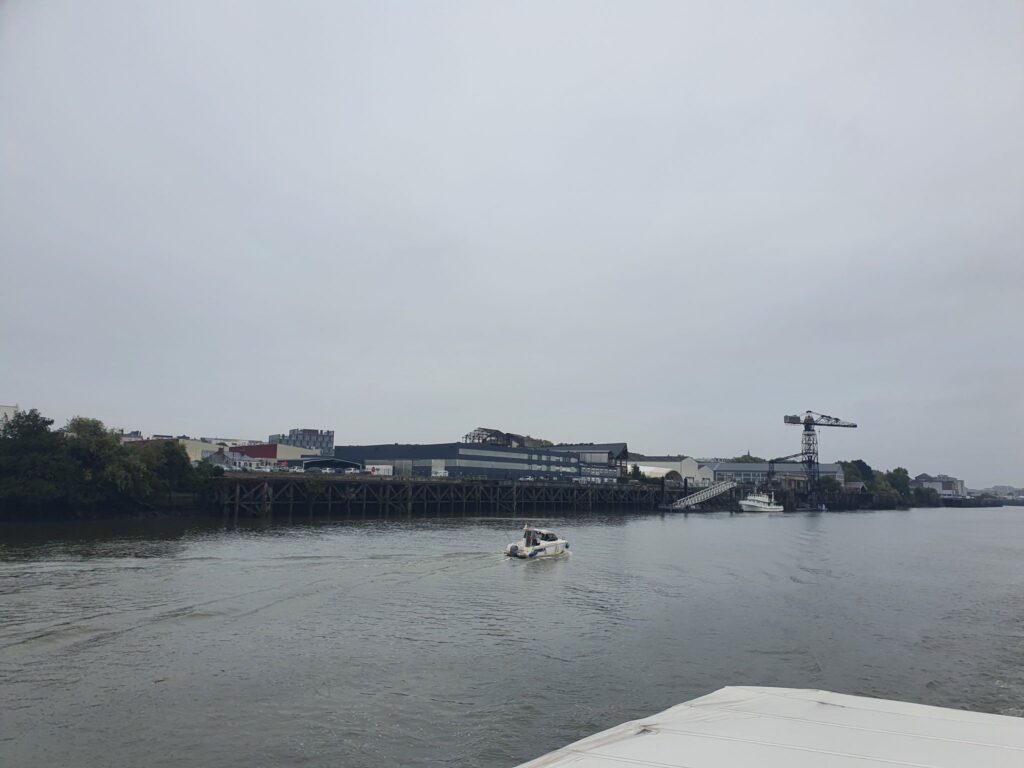
Natural areas coexisting alongside major industrial sites. The south bank is home to the propulsion division of Naval Group, the European leader in naval defense. Once dedicated to shipbuilding and later to cannon foundries, the 400-year-old Nantes site is one of those iconic landmarks that have continually adapted to meet industrial challenges. Its 1,600 employees (out of 17,000) and 400 subcontractors now specialize in propulsion systems for submarines and surface vessels. “Each new generation of aircraft carriers or submarines involves a major industrial transformation,” emphasizes Hélène Le Tarnec, communications manager at the Naval Group site in Nantes.
An Industrial Sector in Transition
An investment of 200 million euros is supporting this large-scale expansion, part of which is visible from the river. In fact, one can see a heavy metal fabrication shop that will be used to machine and weld equipment weighing more than 200 metric tons, work currently underway for the future next-generation aircraft carrier (the largest ever built in Europe), as well as a new boarding pier and assembly shops set to open soon. “Our business is characterized by high precision applied to very large volumes,” comments Hélène Le Tarnec.
With its 600 employees and 28,700 indirect jobs, the Port of Nantes-Saint-Nazaire—France’s fourth-largest seaport and the largest on the Atlantic coast—has also established itself as a major economic player in the Loire Estuary. While port activity is concentrated primarily in the Donges, Montoir, and Saint-Nazaire areas, it also extends upstream, starting just outside Nantes, notably in the Cheviré, Roche Maurice, Cordemais, and Le Pellerin areas.
Nantes Saint-Nazaire Port has undergone numerous major changes since its origins thousands of years ago. With two-thirds of its current traffic linked to fossil fuels, it now faces the major challenge of the energy and ecological transition. The location of the port facilities along the estuary, in the heart of sensitive natural areas (1,177 ha of natural areas), is one of these challenges. “We regularly conduct surveys of flora and fauna to ensure that our operations are conducted in an environmentally responsible manner,” emphasizes Ludovic Bocquier, who is in charge of decarbonization and the energy transition at Nantes Saint-Nazaire Port.
Port operations are transforming to become carbon-free
To address these challenges, the port is working to adapt its infrastructure and develop future-oriented industries, particularly as part of the Loire Estuary Decarbonization Program. Over the past 10 years, 100 million euros have been invested to promote the growth of marine renewable energy, and other projects are planned through 2030, such as the Éole platform, dedicated to the assembly of bottom-fixed and floating wind turbines.
As a result, numerous transition projects are taking shape in the port area, such as Green Coast, led by the startups Lhyfe and Elyse Energy, which aims to produce synthetic methanol from green hydrogen and decarbonize marine propulsion. At the Donges site, the Take Kair project calls for the construction and operation of a production facility for e-fuels intended for aviation. There is also the Go CO2 project, which aims to capture more than two million metric tons of CO2 in the industrial hinterland of Nantes Saint-Nazaire Port. Ludovic Bocquier also notes that Montoir-de-Bretagne will be the home port of the Neoliner Origin, the sailing cargo ship owned by the Nantes-based shipping company Neoline, which is preparing to make its first transatlantic crossing.
The Audacieux, Won Over
As the Iroko docks at the port of Saint-Nazaire, the Audacieuses and Audacieux seem delighted. “Starting from the river to tell the story of the region helps forge a connection between Nantes and Saint-Nazaire. And we have a lot to do together!” says Damien Henry, an Audacieux from Saint-Nazaire since 2021 and representative of the association “À vos soins.”
This view is shared by Géraldine Lecoq, who has been part of Audacieuse for four years and is the founder of Les Nantisiens. “I especially loved the connection to Nantes Saint-Nazaire at the heart of this cruise, but also the chance to see familiar faces again and meet new people—all in a nautical atmosphere, with my hair blowing in the wind under a light drizzle. I loved it!”
Want to get involved in the Audacieux community?