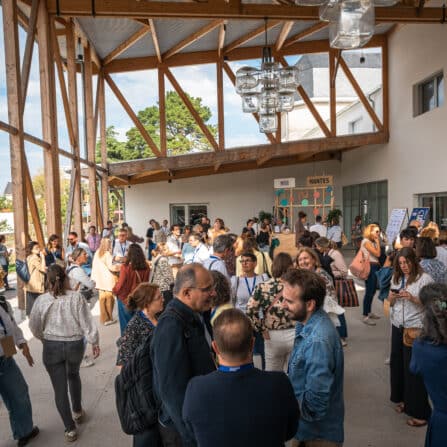
Nantes Saint-Nazaire Développement hosts 50 reuse stakeholders on the eve of the national conference

The morning began with Emilie François-Diehl of Re-vert and Elsa Bortuzzo, co-founder of La Fresque de l’économie circulaire, who emphasized not only the urgency of taking action but also the power of collective effort to accelerate change.
The company tours began at Cyneo, a Nantes-based reuse company in the construction sector that brings together several trades. “We act as a coordinator for Reuse,” explains Anne Bouyé, a project manager who supports construction sites—such as the future Tour Bretagne—in identifying materials and giving them a second life. In the construction industry, “the more we use reuse, the more we reduce carbon emissions,” she emphasizes, noting that regulatory requirements are driving up demand. “We need a dynamic region. The circular economy is a good way to work together and break down barriers—so that our members have access to more sources of materials,” advocates the project manager at Cyneo, a subsidiary of Bouygues.

“The resource pool is the key to Reuse”
This resource base is also the key to Articonnex, a company housed at Cyneo, which recycles up to 30,000 metric tons of materials per year and is developing a plant dedicated to wood remanufacturing. At Articonnex, Emmanuel Morel highlights the immense potential for material recovery in the construction industry. With nine warehouses and a small remanufacturing plant, the company recovers beams, doors, siding, and ceilings to give them a second life. “The key issue is the supply. Construction projects must be coordinated very early on to ensure that reuse is included in the specifications.” At Miroiterie du Reuse, glass is recovered for interior design projects. The same approach is taken at Gueules de Bois, which transforms construction set pieces and structures into custom furniture and fixtures. The most recent example is the reuse of a set piece from the Château des Ducs to create a reception desk for Eiffage.

“Hours of integration per square meter”
Among the most iconic initiatives, Bat’IPAC has made a strong impression with its low-tech, inclusive model: a production line for construction using recycled cardboard, designed for people with disabilities, capable of transforming 4.5 metric tons of cardboard into the walls and roof of a 90-square-meter house every day. “The only material with hours of job training built into every square meter,” notes its director, Alain Marboeuf.

Les Ecossolies, the hub of the social and solidarity economy
The tour continued at Les Ecossolies. Here, the circular economy is taking on a new dimension this year, with the solidarity-based real estate initiative presented by Emilie Sarrazin, the venue’s director. Several startups focused on reuse and the social and solidarity economy came to pitch their ideas. In the healthcare sector, Clémence Cornet of Redeem Medical is preparing her first shipments of refurbished medical devices to hospitals.

Textile Upcycling
When it comes to textile upcycling, Hedj gives new life to HBC Nantes jerseys and Semitan polo shirts, while Artefact transforms kitesurfing sails and technical fabrics into high-end backpacks. La fabrique d’Arachne is also part of this movement toward responsible fashion by repurposing unused textile inventory.
On the Reuse of Digital and Agri-Food Equipment
The event also highlighted responsible digital technology and refurbished solutions: AfB, an inclusive company in Nantes that employs 20 people with disabilities, and Modixia, which collects and recycles eco-designed computer equipment at its low-tech factory in Saint-Herblain.
Finally, reuse also extends to the restaurant industry, with Les Boîtes Nomades, which operates a network of 75 committed restaurants and works with Naofood, as well as Kignon, which transforms unsold baguettes — 600,000 of which are thrown away every day in France — into cookies made by 30 people with disabilities. “Disney and Carrefour are our two newest partners. In reuse, as in other areas, it’s the business that makes the impact,” says Katia Tardy, co-founder of Kignon.
The day continued with visits to other Nantes-based Reuse companies, such as Malakio, Instead, and Bout’ à Bout’.
It is therefore no coincidence that Nantes is hosting the first National Conference on Reuse and the Circular Economy. This momentum illustrates the strength of a region where cooperation and commitment are paving the way for a circular economy that creates jobs and makes a difference.
A project in reuse or the circular economy?