"On the bridge": in Saint-Nazaire, industrial innovation moves forward as a team

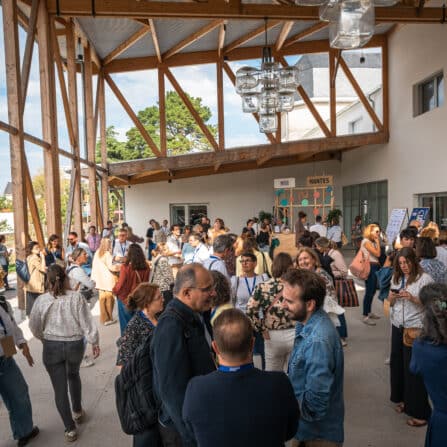
Ghislain de la Gatinais’s lecture set the tone at the opening of the Sur le Pont event. Through his account of Saint-Nazaire’s transformation—“from a fishing village to a major industrial hub”—the historian highlighted the region’s ability to reinvent itself through diversification, adaptation, and collective action. This historical and cultural foundation serves as a wellspring from which local stakeholders draw strength to meet today’s challenges.
9.5 billion euros for the industry in Saint-Nazaire
This ability to reinvent itself is reflected today in the strength and diversity of the local industrial base. Nantes’s industrial sector generates nearly 9.5 billion euros in combined revenue, driven by both the aerospace industry (4.5 billion euros) and shipbuilding (just over 3 billion), as well as by the energy sector (approximately 800 million euros), marine renewable energy (500 million), and the agri-food industry (450 million). The sailing sector is also emerging as a growing industry, with already tangible industrial benefits for the region. This solid industrial foundation provides the region with the support it needs to navigate the ongoing changes.

Innovate to Stay Competitive
In a robust industrial environment that is nonetheless exposed to increased international competition, the ability to innovate appears more than ever to be a key driver for maintaining performance and preparing for future developments. “The ability of our manufacturers to continually improve their performance and diversify into new markets also contributes to the region’s resilience,” says Simon Fradet. The project manager for Territoires d’industrie praises the presence of “a robust academic and research ecosystem that supports innovation, particularly in the decarbonization of the maritime sector, new energy sources, and industrial processes.”
Connecting Small and Medium-Sized Businesses and Mid-Sized Companies to Technology Solutions
For subcontractors, who make up the bulk of the industrial base, innovation is not always a given. Bringing “tech” and “fab” closer together is a critical challenge: the goal is to foster an ecosystem of technological solutions that will improve business productivity. In turn, digital industry players find the ideal conditions within the industrial sector to test and scale up their solutions.
This virtuous cycle is exemplified in practice by the “I Choose My Local French Tech” program. Developed in collaboration with Territoires d’industrie, the program involves assessing and mapping skills and needs, leading to training opportunities, pilot projects conducted with local manufacturers, and, ultimately, a networking platform. “This regional adaptation of a national program has been tailored to the specific needs of the area,” emphasizes Pierre Minier, executive director of French Tech Saint-Nazaire La Baule Pornic.

Innovation: The DNA of Industrial Flagship Companies
This trend resonates particularly strongly with the region’s major clients. “Innovation is one of the keys to remaining competitive in the face of growing Chinese competition and to responding to environmental changes,” says Stéphane Campion, director of the Airbus Atlantic site in Montoir-de-Bretagne. At Airbus, this strategy translates into investments of several billion euros each year in research and development. At Chantiers de l’Atlantique, innovation is part of a culture of continuous improvement, alongside long-term initiatives for progress.
Raphaël Baillot, Director of Technological Innovation and Partnerships at the LACROIX Group, shares this conviction. “In a societal context marked by crises and rapid technological advancements—such as the rise of AI—it is essential to draw on the strength of the collective to innovate and develop useful solutions. At LACROIX, innovation plays a key role in supporting the group’s positive impact strategy.”
Nearly 15,000 new jobs expected in Saint-Nazaire
Despite the highly technical nature of their operations, all stakeholders agree on the central role of people. “Our industry remains very much a manufacturing industry; it needs skilled, trained, and motivated men and women,” insists Stéphane Campion. This conviction is shared by Vincent Hairon, head of industrial performance at Chantiers de l’Atlantique, who believes that performance is also built in collaboration with supplier teams—viewed as co-creators—and by Raphaël Baillot, who closely links performance with resilience: “Having a vision and making the right choices to ensure the company’s long-term viability.”
Everyone finally acknowledges the strength of the Saint-Nazaire community, a true asset for meeting the challenges ahead. With a particularly robust order book—firm orders spanning more than ten years in the aerospace and shipbuilding sectors—and nearly 15,000 new jobs expected, manufacturers are nevertheless warning of the practical challenges associated with this growth momentum, particularly in the areas of training and housing.

Behind the Scenes of Successful Collaborations
This culture of cooperation is best illustrated by two case studies. Faced with the need to bring certain operations back in-house at a site with limited space, Jean Dussetour, CEO of Idea Industries, turned to Spaciotempo’s modular and demountable building solutions. This collaboration was made possible thanks to the Neopolia network.

Another example of a successful collaboration: as part of the DIVA program led by Atlanpole, the startup MaestrIA helped Geps Techno optimize the maintenance of its buoys, which are used for wind farm studies. By analyzing existing data using practical statistical tools—without resorting to complex AI—the project generated a time savings of 250 hours per year.
As the discussions unfold, one thing becomes clear: in Saint-Nazaire, industrial innovation rarely moves forward in isolation. It moves forward as a team, driven by a region where cooperation among manufacturers, innovation leaders, and public partners constitutes a genuine competitive advantage and a strategic lever for collectively tackling the industrial challenges of tomorrow.