The Nantes-Saint-Nazaire region is rallying behind the decarbonization of the maritime sector at the Poseable event

In Nantes on Tuesday, May 13, the Poseable event kicked off a discussion and reflection on the decarbonization of maritime activities. Speaking before an audience of 200 people, Erwan Jacquin, president of Meet2050, called for strategic planning to decarbonize the maritime sector.
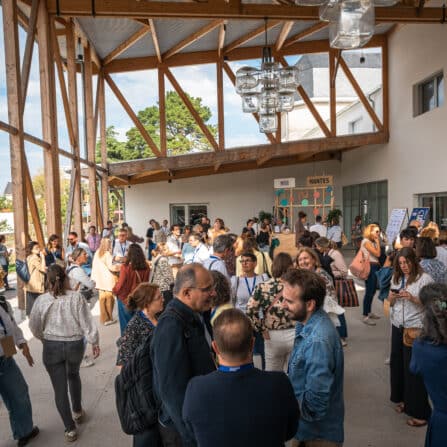
On Tuesday, May 13, Nantes hosted PoSEAble, the first national event dedicated to the decarbonization of maritime activities. Co-organized by the Nantes Saint-Nazaire Développement agency and the Pôle Mer Bretagne Atlantique, this first edition—on a national scale—aimed to foster dialogue and collectively reflect on the challenges and opportunities for a more sustainable maritime future, particularly through maritime transport. The program included plenary sessions, networking, B2B meetings, and forward-looking workshops to explore ways to achieve a more sustainable maritime sector.
“The real issue is energy”
Erwan Jacquin, president and co-founder of the Nantes-based Meet2050 Institute, called for strategic planning to decarbonize the maritime sector. “Today, a shipowner estimates that the return on investment for sail propulsion is less than one year. However, that ROI actually takes several years,” explained the expert. He continued: “The real issue with decarbonizing the maritime sector is energy. We could use methanol, hydrogen, and so on. But at some point, we’ll have to make real choices. We need to start planning now, working with engineering firms and developing economic models. Market constraints and return on investment are difficult to estimate. That’s why we shouldn’t wait for the market to decide for us. We need to anticipate, plan, and set priorities.” Such planning is all the more relevant given that the ports’ strategic plans are drawn up with a 40-year horizon, noted Christophe Leclerc, an economist at Nantes Saint-Nazaire Port.

Envisioning the Ports of the Future
The challenges posed by climate change, energy shortages, and resource scarcity are forcing ports to envision scenarios for the transformation of ports of the future. During a workshop, Frédéric Descombes, head of the Ideas Laboratory at the CEA, presented three port scenarios: the island port, the oyster port, and the polymorphic port. “In the event of an extreme situation, activities could be concentrated in a few European ports. But ports could also be used to increase population density. Insularity is also a concept to consider along every coastline to create an unsinkable port,” the expert summarized.

Shipbreaking in Europe
Finally, the issue of dismantling end-of-life cruise ships. Paul Tourret, Director of the Institut supérieur d’Economie Maritime (ISEMAR) based in Saint-Nazaire, spoke on this issue. “Today, market forces dictate that we dismantle ships by exporting them to Spain or China. We need a strong public policy on this issue. The European steel industry is in need of shipbreaking. Especially since there is a key issue surrounding ‘green steel,’” he explained, even going so far as to envision one of Saint-Nazaire’s three port terminals being dedicated to shipbreaking.
“Rethinking Our Relationship with Resources,” Philippe Bihouix
As the event’s guest of honor, Philippe Bihouix, author of the comic book *Resources: A Challenge for Humanity*, emphasized the urgent need to rethink our relationship with resources. Faced with growing pressure on low-carbon materials, the engineer advocates for moderation, energy sharing, and optimizing usage. Innovation must be as much social as it is technical, involving profound changes in our lifestyles. He warns against the illusion of purely technological progress and calls for government action to accelerate the transition. In his view, we must not underestimate humanity’s capacity to adapt, even if this adaptation must be guided by public authorities.

Check out the event recap
Share knowledge and explore the challenges of decarbonizing the maritime sector. Discover the potential solutions identified during the event on May 13, 2025. Find them in this summary.